Nyamiri-Bàsakkwacḕ: Stories from Another Home is a collection of stories exploring the lived experiences of Nigerians born in, migrated to, or living in Northern Nigeria who are originally from other regions of the country. Book O’Clock invites submissions from writers whose lives reflect this duality and whose experiences meaningfully inform their creative work. The genres in focus include essays, short stories and poetry.
Submissions are expected to be original, unpublished, sincere, reflective, nuanced and not agenda-driven. To maintain this integrity, the collection will prioritise narratives that hold space for complexity and intersectionality by presenting the good, the bad, and the ugly. This approach is based on the understanding that no single narrative can adequately define these experiences.
The director of Book O’Clock and co-editor of the anthology says that Nyamiri-Bàsakkwacḕ also aims at responding to the increasing ethno-religious tensions dominating public conversations. In his words: “Amid Nigeria’s contemporary sociopolitical climate, where ethno-religious tensions and conflict increasingly dominate public discourse, Nyamiri-Bàsakkwacḕ seeks to interrogate these realities by foregrounding shared humanity without erasing differences.”
Submission Guidelines
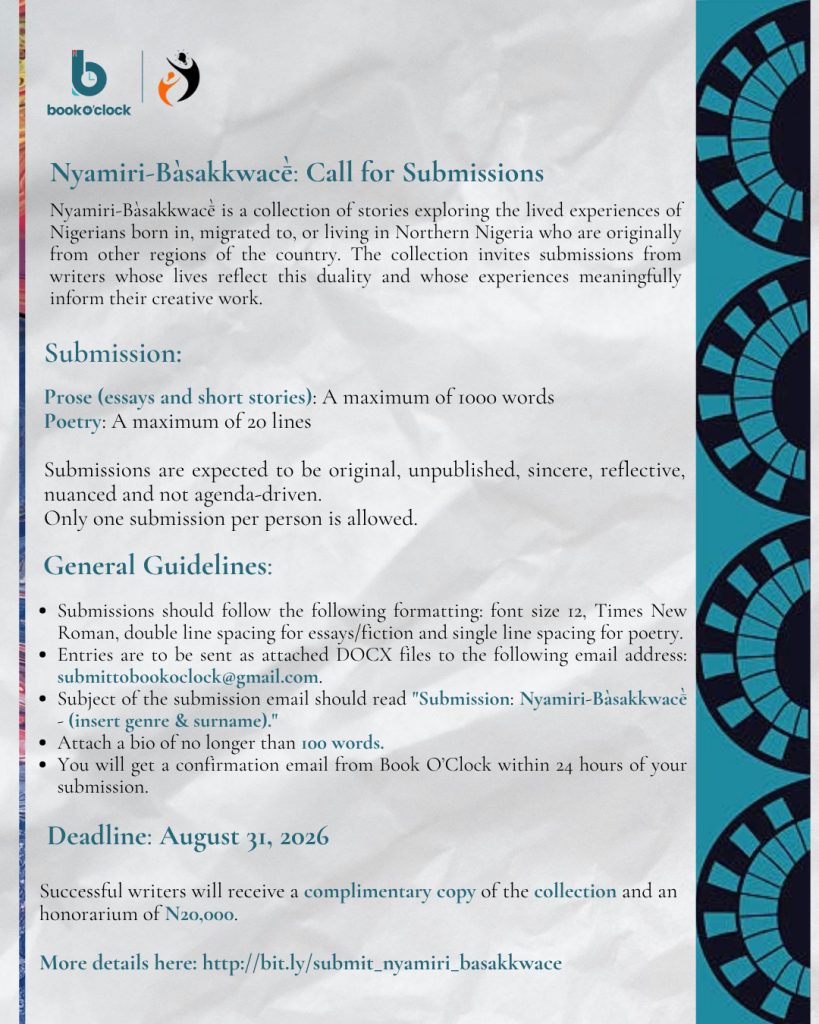
- Prose (essays and short stories): A maximum of 1000 words.
- Poetry: A maximum of 20 lines.
- Only one submission per writer is allowed.
- Submissions should follow the following formatting: 12-point Times New Roman, double line spacing for essays/short stories, and single line spacing for poetry.
- Entries are to be sent as attached DOCX files to the following email address: submittobookoclock@gmail.com.
- The subject of the submission email should read “Submission: Nyamiri-Bàsakkwacḕ – (insert genre & surname).
- Attach a bio of no more than 100 words that also includes your state of origin and the Northern Nigerian city your work reflects.
- You will get a confirmation email from Book O’Clock within 24 hours of your submission.
Deadline: August 31, 2026
Successful writers will receive a complimentary copy of the collection and an honorarium of N20,000 Naira.
About the Editors
Given the project’s sensitivity and niche focus, the collection is edited by creatives with similar backgrounds. Northern Nigeria-based writer and editor Ifeanyichukwu Eze will serve as editor, with Uchenna Emelife, founder of Book O’clock and the director of the Sokoto Book and Arts Festival, as co-editor.
Ifeanyichukwu Eze is a writer, editor, and writing instructor. His work has appeared in The Rumpus, The Offing, Joyland, Guernica, Adda, and The Dark. His short story, ‘In Another Country’, was shortlisted for the 2020 Commonwealth Short Story Prize. He studied Philosophy at the University of Nigeria, Nsukka. Uchenna Emelife, on the other hand, is a curator, bookseller and researcher. An Erasmus Mundus scholar, he explores the intersection of decolonial thought and childhood and children’s literature. In 2020, he founded Book O’Clock to promote critical and transformative literacy in Nigeria and co-founded the Sokoto Book and Arts Festival, engaging over 1,000 participants in cultural discourse and creative performance.
About the Title: Nyamiri-Bàsakkwacḕ
Nyamiri-Bàsakkwacḕ, which loosely translates to “an Igbo-Sokoto person” in Hausa, is a common label for Igbo Nigerians who have resettled in Sokoto, whether for business, education, or family life. These individuals often speak Hausa, attend local functions, and relate with indigenes to such an extent that they are perceived as fellow Sokoto people.
The term Nyamiri itself (the Hausa designation for Igbo people) has contested origins. Scholarly studies on inter-ethnic naming practices in Nigeria show that such labels often emerge through everyday interaction, phonetic approximation, and historical contact, and may undergo semantic shifts over time rather than possessing a single fixed origin (Eze & Chiemezie, 2024). Some accounts trace the term to a mocking adulteration of the Igbo phrase “Nyem m mmiri” (“Give me water”), which Igbos stranded in the North were said to repeat during the Nigeria–Biafra War. Others argue that it emerged from how Igbos in the North referred to water vendors as “Onye Mmiri” (water person).
Nyamiri-Bàsakkwacḕ, however, functions differently. As a compound label, it gestures toward recognition—acknowledging the dual positionality of those once perceived as strangers but who have since found, or actively made, a home in Sokoto while retaining their original identity. In this sense, it disarms the perceived malice of “Nyamiri” as a standalone term and instead emphasises shared belonging. Nyamiri-Bàsakkwacḕ as a literary project is situated within this context.
Project Funding: Open Arts Development Foundation
Press Contact:
Uchenna Emelife